Quality Gurus
- Certification
- Auditing
A pattern we encounter with painful regularity: an organisation proudly shows us its ISO 9001 certificate, a customer or tender authority has just rejected it, and the owner cannot understand why. The certificate is real, in the sense that someone printed and sold it. It is worthless, in the sense that matters: because the body that issued it holds no recognised accreditation, no meaningful audit ever took place, and the customer's procurement team checked. The money is gone, the tender deadline is missed, and the certification project starts over.
Egypt's market has a genuine certificate-mill problem, and it survives because the accreditation system that separates real certificates from decorative ones is poorly understood. Here is how it works and how to protect yourself.
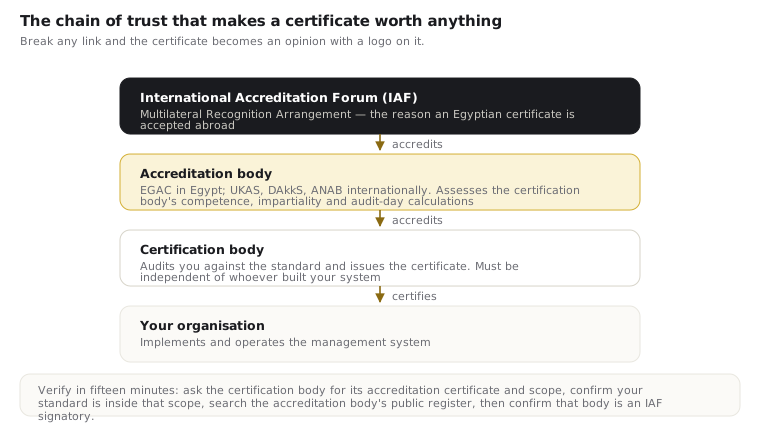
How the chain of trust actually works
Three layers, each checking the one below:
- Your organisation implements a management system.
- A certification body (CB) audits you against the standard and issues the certificate.
- An accreditation body assesses the certification body (its auditor competence, impartiality, audit-day calculations and processes) and accredits it to certify against specific standards.
The top layer is what makes the system international: national accreditation bodies that are members of the International Accreditation Forum (IAF) and its multilateral recognition arrangement. In Egypt, the national body is EGAC (the Egyptian Accreditation Council), an IAF MLA signatory; international CBs operating in Egypt typically carry accreditation from bodies like UKAS (UK), DAkkS (Germany) or ANAB (US). A certificate from a CB accredited by any IAF-member body is recognised globally. A certificate without that chain is an opinion with a logo.
The red flags that identify a mill
After years of preparing clients for certification (and our lead consultant's years auditing for accredited CBs) the warning signs are consistent:
- Certificate promised in days or weeks. A legitimate initial certification requires a two-stage audit with real auditor-days on site, scaled to your headcount and scope. "ISO 9001 in one week, guaranteed" is describing a printing service.
- Consultancy and certificate from the same provider. Accreditation rules require CBs to be impartial: a body that builds your system cannot credibly certify it. Bundled "we implement and certify" offers fail this test by definition.
- "Guaranteed pass." An audit with a guaranteed outcome is not an audit.
- Accreditation claims that dissolve under inspection: logos of accreditation bodies that don't list the CB, accreditation from bodies that are not IAF members, or self-created "international accreditation associations" that accredit anyone who pays.
- Prices that make no arithmetic sense. Auditor-days cost money. A certification quote far below every accredited competitor is cheap because the audit inside it is imaginary.
How to verify: in fifteen minutes
- Ask the CB directly for its accreditation certificate and scope: which accreditation body, and, critically, is your standard within the accredited scope? A CB accredited for ISO 9001 issuing ISO 22000 certificates outside its scope is a subtler version of the same problem.
- Check the accreditation body's public register. EGAC, UKAS, DAkkS and peers publish searchable lists of the CBs they accredit and for what.
- Cross-check IAF membership of the accreditation body at the IAF's own site: this defeats the fake-accreditor trick.
- Sanity-check the audit-day quote. Accredited CBs calculate audit duration from standardised tables based on your size and complexity. Ask how many days are quoted and compare between CBs: an outlier low number is a signal, not a bargain.
Choosing between legitimate CBs
Once accreditation is verified, real differentiators remain: sector experience of the audit team (a food-sector CB auditor who knows BRCGS and FSSC realities adds value; a generalist adds friction), your customers' preferences (some buyers name acceptable CBs), Arabic-language audit capability, scheduling reliability for surveillance visits, and total three-year-cycle cost rather than year-one price. Cheapest-accredited is a defensible strategy; cheapest-overall never is.
Practical steps
Verify before you sign: accreditation body, scope, IAF membership, audit-day count. If a certificate you already hold fails these checks, budget emotionally and financially for recertifying properly: accredited CBs give no credit for mill certificates, and the system behind the certificate usually needs real work too. QG prepares organisations for certification and advises on CB selection: we hold no commercial ties to any certification body, which is exactly why we can advise on choosing one.