Quality Gurus
- Sustainability
- Environment & Energy
Since 1 January 2026, the EU's Carbon Border Adjustment Mechanism (CBAM) is no longer a reporting exercise. The transitional phase (quarterly reports, no payment) is over. EU importers of covered goods must now surrender CBAM certificates priced against the EU carbon market for the embedded emissions in what they import. For Egyptian industry, this lands squarely on the export sectors that matter most: iron and steel, cement, aluminium, fertilizers, and hydrogen.
We work with exactly these sectors on energy and carbon, and the pattern we see is concerning: many exporters still treat CBAM as their EU customer's problem. It is not. Here is why, and what to do about it.
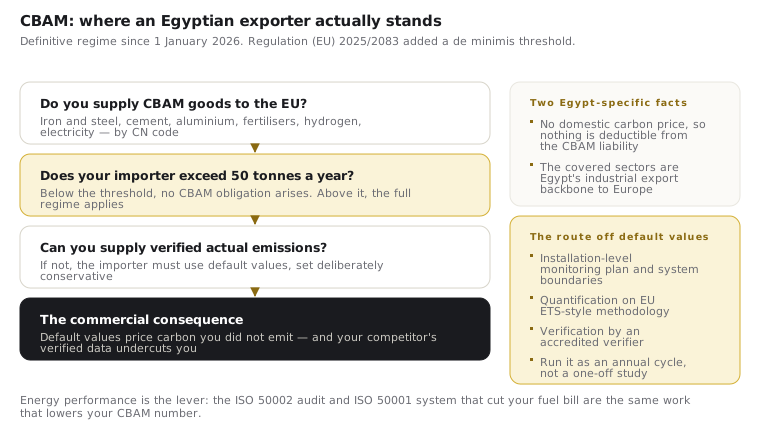
Why this is your problem, not just your importer's
The legal obligation sits with the EU importer: they file the declaration and buy the certificates. But the cost flows straight back down the contract. An importer facing a CBAM bill on your goods has three options: pass the cost to you through pricing, demand verified emissions data from you to reduce the bill, or source from a supplier with lower verified emissions. Every one of those options lands on your commercial position.
Before any of that, though, establish whether the regime bites at all. The EU's "Omnibus" simplification package — Regulation (EU) 2025/2083, in force from October 2025 — introduced a de minimis threshold of 50 tonnes per importer per calendar year for cement, iron and steel, aluminium and fertilisers (electricity and hydrogen are excluded from the exemption). Below that cumulative annual mass, no CBAM obligation arises. The Commission's stated design is that this exempts around 90% of importers while keeping roughly 99% of covered emissions in scope — which tells you exactly who it helps and who it does not. If you ship in volume to industrial buyers, you are firmly in scope; if you ship small quantities to many small importers, some of those customers now have no CBAM exposure on your goods at all. Establish which of your importers sit on which side of that line before you invest in anything, because it changes both your cost exposure and your commercial argument.
For those above the threshold, the mechanism that decides how hard it lands
Egypt's specific exposure
Two structural facts sharpen the picture for Egyptian producers. First, Egypt operates no domestic carbon pricing scheme, so there is no carbon price already paid at home to deduct from the CBAM liability: the full EU carbon price applies. Second, the covered sectors are precisely Egypt's industrial export backbone to Europe: steel, cement, aluminium, and nitrogen fertilizers (urea and ammonia). Producers in these sectors competing for EU volume against suppliers who can show low verified embedded emissions are now competing on carbon data as much as on price.
What "verified actual values" requires
To move off default values, you need a monitoring, reporting and verification (MRV) capability at installation level:
- System boundaries and monitoring plan. Define the production processes for the CBAM goods, the emission sources (fuel combustion, process emissions, purchased electricity where relevant), and how each is measured.
- Emissions quantification against a recognised methodology. The CBAM rules build on EU ETS-style monitoring. Organisations already working with the GHG Protocol or ISO 14064-1 have a head start; the disciplines are the same: activity data, emission factors, calculation transparency. See our comparison of GHG Protocol and ISO 14064.
- Verification. The data must be verified by an accredited verifier for your importer to use it. Unverifiable spreadsheets do not move you off defaults.
- Repeatability. This is not a one-off study. It is an annual cycle, which means it needs to run as a management system, not a project.
The energy connection most exporters miss
Embedded emissions are substantially a function of energy performance. The same ISO 50001 energy management and ISO 50002 energy audit work that cuts your electricity and fuel bills is also the main lever that lowers your CBAM number. We increasingly scope these as one programme: energy audit to find the reductions, energy management system to hold them, MRV to convert them into verified data your EU customers can use. Each euro of carbon cost avoided at the border is won inside the plant first.
What to do this quarter
- Confirm your exposure. List your CN codes against the CBAM scope. If you supply covered goods to the EU (directly or through traders) you are in scope commercially, whoever files the paperwork.
- Talk to your importers now. Ask what data they need, in what format, and whether they are currently declaring your goods on default values. If they are, quantify what that is costing versus your best estimate of actual emissions.
- Baseline your emissions. An installation-level GHG inventory against ISO 14064-1 or the GHG Protocol is the foundation for everything else, and it is the piece that takes longest to do properly.
- Plan for verification. Build the inventory from the start with verification in mind: documented methodology, traceable activity data, defensible emission factors.
Practical steps
CBAM rewards exactly one thing: credible, verified emissions data, produced year after year. That is a management-systems discipline, and it is buildable in months, not years, if the data foundations exist. QG supports Egyptian industrial exporters with GHG inventories, CBAM-readiness and energy auditing across the covered sectors. Contact us for a scoped assessment of your exposure and your fastest route off default values.