Quality Gurus
- Sustainability
- Environment & Energy
When an organisation decides (or is told by a customer, a lender or a regulation) that it needs a carbon footprint, the first practical question is which framework to use. The two names that dominate are the GHG Protocol and ISO 14064, and the most common misconception we correct is that you must choose one against the other. They are different kinds of documents doing different jobs, and mature carbon programmes usually end up using both.
What the GHG Protocol actually is
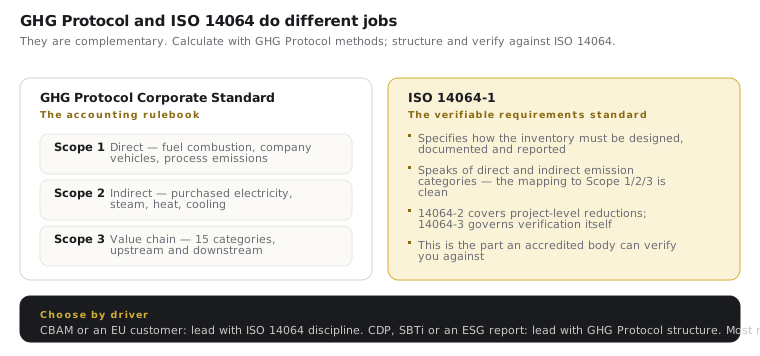
The GHG Protocol Corporate Standard is the accounting rulebook: it defines what counts, how to draw organisational and operational boundaries, and the Scope 1 / 2 / 3 structure that has become the universal language of corporate carbon:
- Scope 1: direct emissions from sources you own or control: fuel combustion in boilers and furnaces, company vehicles, process emissions.
- Scope 2: indirect emissions from purchased electricity, steam, heat and cooling.
- Scope 3: everything else in the value chain, upstream and downstream: purchased goods, transport, product use, and more, across fifteen categories.
Its strength is methodological depth (calculation guidance, emission-factor conventions, sector guidance) and universal recognition: CDP, the Science Based Targets initiative and most ESG disclosure frameworks are built on its vocabulary.
What ISO 14064 actually is
ISO 14064-1 is a requirements standard for the organisation-level GHG inventory: the thing an accredited body can verify you against. It specifies how the inventory must be designed, documented and reported so that an independent verifier can assess it. (Its siblings: ISO 14064-2 covers project-level reductions, ISO 14064-3 governs the verification process itself, and ISO 14067 covers product carbon footprints.) Rather than Scope 1/2/3, it speaks of direct and indirect emission categories, but the mapping is clean and the two are designed to be used together: calculate with GHG Protocol methods, structure and verify against ISO 14064-1.
The decision, by driver
- An EU customer or CBAM is the driver. Lead with ISO 14064-1 discipline, because CBAM's value comes from verified data: the verifiable inventory is the asset, and ISO 14064-3 is the verification route. The GHG Protocol still supplies your calculation methods underneath.
- An ESG report, CDP disclosure or science-based target is the driver. Lead with the GHG Protocol (its Scope 1/2/3 structure is what those frameworks expect) and add ISO 14064-1 conformity when assurance becomes a requirement, which it increasingly does.
- A parent company or lender requires "a verified footprint". Ask precisely what they mean. In our experience the answer is usually an inventory built on GHG Protocol methods, verified against ISO 14064-3. Building it that way from day one avoids re-work.
Where organisations actually go wrong
The framework choice is rarely what sinks a first carbon footprint. These are:
- Boundary confusion. Which sites, subsidiaries and shared facilities are in? Equity share or operational control? Decide once, document it, apply it consistently: inconsistent boundaries are the first thing verifiers challenge.
- Emission factors without provenance. Every factor needs a source and a year. Factors pulled from an old spreadsheet with no citation fail verification.
- Scope 2 handled one way when two are required. Location-based and market-based accounting both exist for a reason; report both where relevant.
- A one-off study instead of a system. The footprint that matters is next year's, produced the same way, comparable to this year's. That requires documented methodology, assigned ownership and a data-collection calendar: a management system, which is exactly the discipline ISO-based organisations already have.
Practical steps
Write down who is asking for your footprint and what they will do with it: that single sentence usually decides the framework emphasis. Start the data inventory now (fuel purchases, electricity bills, production data are the long lead items). Build with verification in mind even if verification is not yet required. QG delivers GHG inventories, verification preparation and CBAM readiness for industrial organisations in Egypt and the region: four carbon-footprint engagements for large organisations are on our 2026 delivery plan, and the methodology above is exactly how we run them.