Quality Gurus
- Food Safety
- Certification
The Foundation FSSC published Version 7 of the FSSC 22000 scheme on 1 May 2026, and it is a substantial revision rather than a tidying exercise. It adopts the latest ISO 22002 prerequisite programme series, aligns the scheme to the GFSI Benchmarking Requirements 2024, and strengthens expectations on sustainability and environmental performance.
For sites certified to Version 6, the timeline is fixed and comfortable if you start now, and uncomfortable if you do not. The organisations that treat a scheme transition as a documentation refresh tend to discover, at the upgrade audit, that several requirements need operational evidence accumulated over months.
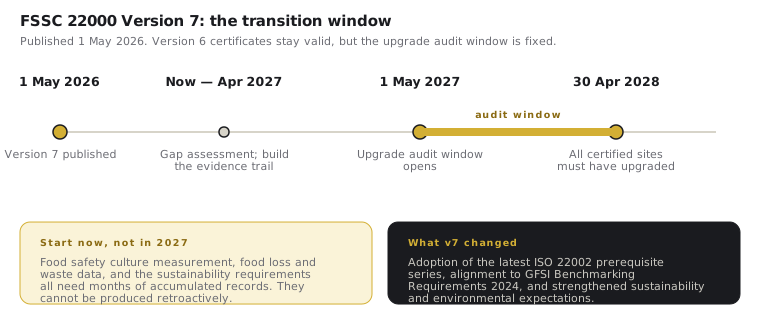
The transition timeline
- 1 May 2026 — Version 7 published.
- Now to 30 April 2027 — Version 6 audits continue. This is your gap-assessment and build period, and it is where the work belongs.
- 1 May 2027 to 30 April 2028 — the upgrade audit window. All certified organisations must complete their Version 7 upgrade audit within it.
- From 1 May 2028 — all audits are conducted against Version 7.
Your certificate does not lapse if you plan within this window. What causes disruption is starting late and discovering that the evidence-based requirements cannot be manufactured retroactively.
What Version 7 changed
- The ISO 22002 prerequisite series update. The sector-specific PRP standards underneath the scheme have moved. This is the change with the widest operational footprint, because PRPs touch fabrication, hygiene, maintenance and supplier control across the whole site — and because a PRP gap tends to surface as several findings rather than one.
- Alignment to GFSI Benchmarking Requirements 2024. The scheme has been re-benchmarked against the current GFSI requirements, which is what preserves the commercial recognition your buyers rely on.
- Strengthened sustainability and environmental requirements, continuing the direction Version 6 opened. This is the area where food-safety teams most often lack existing data and existing ownership.
- Continuation and sharpening of the Version 6 additional requirements — food safety and quality culture, food loss and waste, equipment management, allergen management, food defence and food fraud mitigation, environmental monitoring.
Why "documentation-only" transitions fail
Several of these requirements share a characteristic: they need evidence accumulated over time, not a written procedure. A culture measurement taken the week before the audit, or a food-waste baseline with no trend behind it, reads exactly as what it is. Auditors assess whether these are live programmes or transition-day theatre, and they do it by talking to people across the site rather than by reading the manual.
This is the whole argument for starting in 2026 rather than 2027: the requirements that need a genuine record — typically several months of it — are the ones that set your real timeline.
A transition plan that protects your certificate
- Gap assessment against Version 7, this quarter. Map your current Version 6 system against every change and classify each gap as documentation (fast) or evidence-requiring (needs runway). The evidence-requiring gaps set the schedule; everything else fits around them.
- Start with the PRP realignment. The ISO 22002 update is the largest structural change and frequently needs engineering, procurement and maintenance involvement with genuine lead times.
- Stand up the evidence-requiring programmes early. Culture objectives and measurement, food loss and waste baselining and targets, and the sustainability data set all need months of records, not days.
- Update documentation in parallel, not first. Documentation written before the operational reality exists describes an imaginary site, and auditors notice within an hour.
- Awareness across the site. The culture requirement means the whole workforce, not just the food-safety team, needs to feel the change: training that reaches the floor, in Arabic and English.
- Internal audit against Version 7, then a readiness review. Confirm the new programmes are producing evidence before the certification body arrives. A pre-external audit review timed a few weeks out is the cheapest protection against an upgrade-audit surprise.
Where FSSC sits among the alternatives
If you are choosing a scheme rather than transitioning one, the comparison between HACCP, ISO 22000 and FSSC 22000 is the place to start, and BRCGS is the other GFSI-recognised route your buyers may specify by name. Ask your three most important customers which certificates they accept before committing: that answer decides the project more reliably than any feature comparison.
Practical steps
If you are Version 6 certified, obtain the Version 7 scheme documents and run the gap assessment this quarter — the PRP realignment, culture measurement and sustainability elements all need lead time you cannot recover later. Book the upgrade audit early in the window rather than late; the last quarter before April 2028 will be the busiest your certification body has. QG supports FSSC 22000 sites through scheme version transitions across Egypt and the region, timing the work so certification continues uninterrupted.
Scheme dates and requirements are as published by the Foundation FSSC. Confirm the current version and your own transition dates with your certification body before planning.