Quality Gurus
- Sustainability
- Certification
Egypt's textile and apparel exporters face a certification landscape that has become a buying requirement rather than a marketing choice: European and American brands now specify sustainability certifications in their supplier manuals, and "which certificate?" decides whether you can quote for the order at all. The confusion is real (organic standards, recycled standards, chemical-safety labels and chain-of-custody schemes with overlapping acronyms), and certifying to the wrong one is an expensive way to learn the difference.
Our practice has textile manufacturing in its DNA (our lead consultant's industrial career ran through home textiles), so here is the landscape, organised by the claim each certification lets your buyer make.
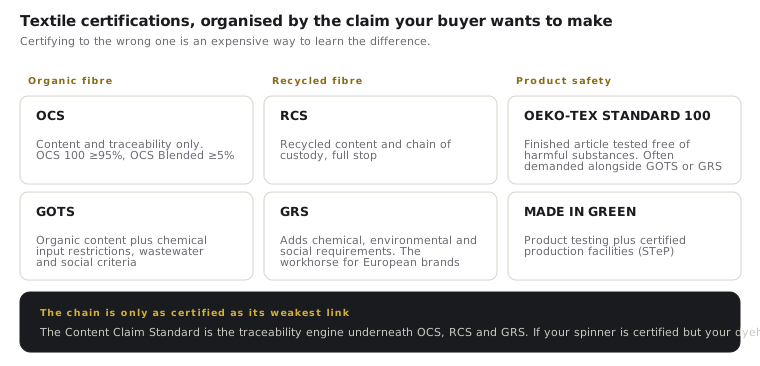
The organic family: GOTS and OCS
Both certify organic fibre content, verified through an unbroken chain of custody from the fibre to the finished product. The difference is what else they demand:
- OCS (Organic Content Standard) is purely a content-and-traceability claim: it verifies the organic fibre percentage in the product (OCS 100 for ≥95%, OCS Blended for ≥5%) and nothing more. No chemical, environmental or social criteria.
- GOTS (Global Organic Textile Standard) is the demanding one: organic content plus strict chemical input restrictions at every processing stage, wastewater treatment requirements, and social criteria. GOTS certification of a dyehouse or garment factory is a full processing-standard audit, not a paperwork exercise.
The buyer logic: brands making a simple "made with organic cotton" content claim may accept OCS; brands positioning products as genuinely organic (particularly in the EU) increasingly require GOTS through the whole chain. Ask which claim your buyer prints on the label; that answers the question.
The recycled family: RCS and GRS
The same architecture, applied to recycled content:
- RCS (Recycled Claim Standard) verifies recycled content and chain of custody, full stop.
- GRS (Global Recycled Standard) adds chemical restrictions, environmental management requirements (wastewater, energy) and social criteria on top of the recycled-content verification.
With recycled polyester now standard in European collections, GRS has become the workhorse certification of the recycled market, and for many buyers the default demand, because it lets them make both the content claim and responsibility claims about the supply chain behind it.
The chain-of-custody spine: CCS
The Content Claim Standard (CCS) is the traceability engine underneath OCS, RCS, GRS and other Textile Exchange standards: the rules for how certified material is documented, segregated and transferred between certified organisations, with transaction certificates accompanying every shipment. The practical implication exporters must internalise: the chain is only as certified as its weakest link. If your spinner is certified but your dyehouse is not, the claim dies at the dyehouse. Building an order's supply chain means confirming every processor's certification scope before committing delivery dates; scope gaps discovered mid-production are a familiar disaster.
OEKO-TEX: a different question entirely
The OEKO-TEX family answers a different buyer concern. STANDARD 100 certifies that the finished article is tested free of harmful substances above limit values (a product-safety claim, not a fibre-origin claim) and is often demanded alongside GOTS or GRS. MADE IN GREEN combines product testing with certified production facilities (STeP); ECO PASSPORT covers the chemicals themselves. Many exporters need STANDARD 100 as a baseline for European retail regardless of which content certification they hold.
The decision guide
- Buyer prints "organic" on the label, EU-focused: GOTS through every processing stage. Plan for the chemical and wastewater requirements: they drive real operational change in wet processing.
- Buyer makes a content claim only ("made with X% organic/recycled"): OCS or RCS respectively, faster and cheaper, but confirm the buyer accepts it before choosing the economy route.
- Recycled synthetics for European brands: GRS, almost always.
- General European retail access: OEKO-TEX STANDARD 100 as the product-safety baseline, whatever else you hold.
- Also facing social-compliance demands: these schemes' social criteria do not replace SA8000, BSCI or SEDEX audits; most exporters end up holding both a content certification and a social-compliance membership.
Practical steps
Collect the supplier manuals of your three most important target buyers and list the certifications each demands: the intersection is your certification plan. Map your full processing chain and verify every subcontractor's certification scope. Then sequence the implementation: chain-of-custody systems and transaction-certificate discipline first, processing-standard requirements (chemicals, wastewater) in parallel where GOTS or GRS applies. QG implements textile sustainability certifications across the full Textile Exchange, GOTS and OEKO-TEX landscape, with the shop-floor fluency that comes from having run textile manufacturing, not just audited it.