Quality Gurus
- Sustainability
- Auditing
- Certification
Any Egyptian manufacturer supplying European or American retail has met the social-compliance questionnaire: proof of decent labour conditions, no child or forced labour, safe workplaces, fair hours and wages. The confusion is which scheme satisfies it: buyers name SA8000, BSCI or SEDEX, sometimes interchangeably, sometimes insisting on a specific one, and they are three genuinely different things. Certifying to the wrong one, or misunderstanding what "SEDEX membership" actually delivers, is a familiar and expensive mistake.
Here is what each one actually is.
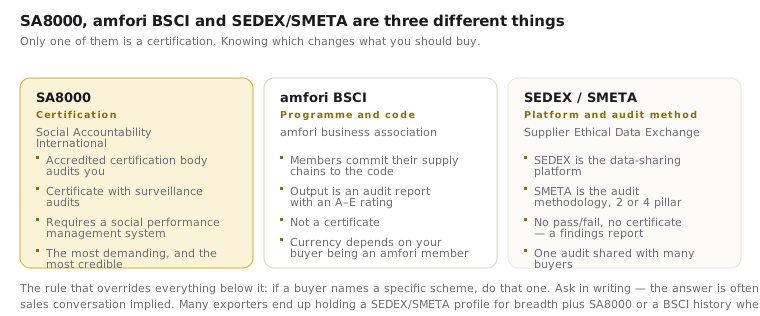
SA8000: a certification standard
SA8000, from Social Accountability International, is the most rigorous of the three and the only true certification. It sets auditable requirements across nine areas: child labour, forced labour, health and safety, freedom of association, discrimination, disciplinary practices, working hours, remuneration, and a management system to sustain them. An accredited certification body audits you and, if you conform, issues a certificate valid for a fixed period with surveillance audits between, the same accredited-certification architecture as ISO standards.
The management-system requirement is what distinguishes SA8000: it demands a functioning social-performance management system, not just a passing audit-day snapshot. That makes it the most demanding to achieve and the most credible to hold.
BSCI (amfori BSCI): a programme and a code
amfori BSCI is not a certification; it is a programme run by the amfori business association. Members (mostly European retailers and importers) commit their supply chains to the amfori BSCI Code of Conduct, and suppliers are audited against it. The output is not a certificate but an audit report with a rating (A to E), valid for a defined period. Many European buyers are amfori members and will ask suppliers to undergo an amfori BSCI audit and share the result through the amfori platform.
The practical distinction: with BSCI you hold an audit result, not a certificate, and its currency depends on the buyer being an amfori member who values it.
SEDEX / SMETA: a platform and an audit methodology
SEDEX (Supplier Ethical Data Exchange) is, at its core, a membership platform for sharing ethical supply-chain data. The audit associated with it is SMETA (Sedex Members Ethical Trade Audit), a widely used audit methodology (2-pillar or 4-pillar, covering labour, health and safety, and optionally environment and business ethics). Crucially, SMETA is an audit method, not a certification and not a pass/fail scheme: it produces a report of findings that you upload to the SEDEX platform and share with any customer who is also a member.
SEDEX's strength is efficiency: one SMETA audit, shared with many buyers, avoiding repeated audits of the same site. Its output is transparency, not a certificate.
The decision guide
- A specific buyer names a specific scheme: do that one. This overrides everything below: the buyer's requirement is the requirement.
- Your buyers are amfori members: an amfori BSCI audit is likely the direct ask.
- You supply many buyers and want audit efficiency: SEDEX membership with a SMETA audit lets one audit serve many customers, which is why it is popular with suppliers to fragmented customer bases.
- You want the strongest, most independent credential, or a buyer specifies it: SA8000 certification, the only one that is genuinely a certification and carries a management-system requirement.
- The common reality: many exporters end up holding more than one: a SEDEX/SMETA profile for breadth, plus SA8000 or a BSCI history where specific buyers demand it.
How these relate to your other certifications
Social compliance sits alongside, not inside, your quality and sustainability certifications. The social criteria embedded in GOTS or GRS do not replace a SMETA audit or SA8000, and vice versa; buyers typically want both the product certification and the social-compliance evidence. The efficiency to chase is shared groundwork: the health-and-safety, working-hours and documentation disciplines overlap substantially, and an integrated approach to the underlying management system reduces duplicated effort across all of them.
Practical steps
Ask your key buyers, in writing, exactly which scheme and which report they accept: the answer is often more flexible, or more specific, than the sales conversation implied. Map the overlap between whatever you choose and your existing safety and quality systems to avoid auditing the same controls three times. QG prepares manufacturers for social-compliance audits and certification across SA8000, amfori BSCI and SMETA, with the documentation and floor-level practice that survives a real audit.