Quality Gurus
- ISO 9001
- Certification
Most organisations that come to us for ISO 9001 have already tried to start on their own. They downloaded the standard, assigned it to a quality coordinator alongside their day job, and six months later they have a folder of procedures nobody follows and no clear idea how far they are from certification. The problem is rarely effort: it is sequence. ISO 9001 certification is a defined process with a defined order, and doing the steps out of order is what wastes time and money.
This article lays out the complete journey as we run it, with realistic timelines for each stage.
Step 1: Understand what you are actually buying
ISO 9001 certification involves two separate organisations, paid separately. A consultancy (like Quality Gurus) prepares your management system; an accredited certification body (which must be independent of your consultant) audits it and issues the certificate. Any provider offering to "sell" you both preparation and certificate in one package is describing an unaccredited certificate, which most serious customers and tenders will reject. We covered the full cost structure in our ISO 9001 cost guide.
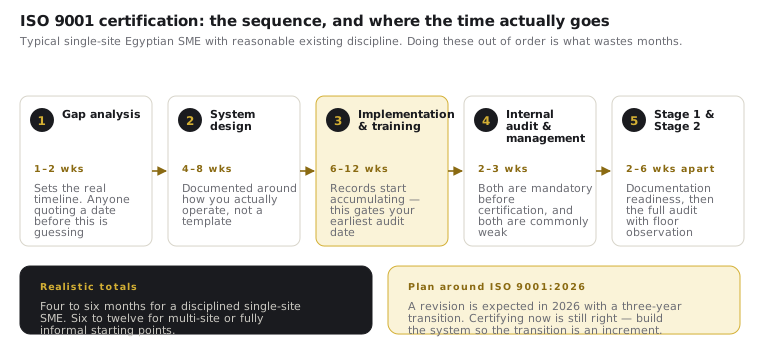
Step 2: Gap analysis (1–2 weeks)
Before designing anything, assess what already exists. A proper gap analysis reviews your current processes, documentation and records against every clause of ISO 9001:2015 and produces a prioritised gap list. Two things make this stage decisive:
- It sets the real timeline. An organisation with disciplined, documented processes may be audit-ready in four months; one working entirely informally may need nine or more. Anyone quoting a timeline before a gap analysis is guessing.
- It prevents over-engineering. The most common failure mode we see is a system copied from a template: forty procedures for a company that needs twelve. The standard requires you to document what your operation genuinely needs, nothing more.
Step 3: System design and documentation (4–8 weeks)
The system is designed around how you actually operate: your process map, your quality policy and objectives, the documented information the standard requires, and the records that will prove the system runs. Good documentation describes what your people really do, tightened where the standard demands it. If a procedure describes an imaginary company, auditors notice within an hour, because the records will not match.
Step 4: Implementation and training (6–12 weeks)
A documented system is not an implemented one. This phase is where certification is genuinely won: processes are rolled out, staff are trained on the parts that touch their work, and (critically) records begin to accumulate. Certification bodies expect to see evidence that the system has operated for a meaningful period, typically three months of records, before the certification audit. This is the stage that fixes your earliest possible audit date, so start it as early as possible.
Step 5: Internal audit and management review (2–3 weeks)
ISO 9001 requires both before certification. The internal audit must be objective (which is why organisations without trained internal auditors bring in an external one) and it must cover the whole system, not a sample. The management review is where leadership formally examines audit results, performance data and improvement actions. Auditors read internal audit and management review records carefully: weak ones are among the most common findings at certification audits.
Step 6: Choose your certification body carefully
Verify accreditation, not just reputation. An accredited body is one accredited by a recognised member of the International Accreditation Forum (IAF): in Egypt, look for accreditation from EGAC or major international bodies. Ask for the accreditation certificate and scope, and check the certificate you will receive carries the accreditation mark. We wrote a full guide to avoiding certificate mills, because unaccredited certificates are common in the Egyptian market and worthless in serious supply chains.
Step 7: Stage 1 and Stage 2 audits
Certification happens in two stages. Stage 1 is a documentation and readiness review: the auditor confirms your system covers the standard and you are ready for full assessment. Stage 2, typically two to six weeks later, is the full audit: interviews, records, shop-floor observation. Findings are classified as major or minor nonconformities; majors must be closed before the certificate is issued. A pre-external audit review run a few weeks before Stage 1 is the cheapest insurance available: it catches findings while they cost days, not audit cycles.
Step 8: Certification, and the three-year cycle
The certificate is valid for three years, with surveillance audits (usually annual) in between and recertification at the end. Systems that are run only in the month before each surveillance audit deteriorate quickly and get caught; ongoing maintenance exists precisely to keep the system genuinely alive between visits.
A note on the ISO 9001:2026 revision
ISO 9001 is under revision, with publication expected in 2026 and a transition period of around three years for certified organisations. This is not a reason to delay certifying — you would be waiting a year to then wait three more — but it does affect how you build. Design the system around your actual processes rather than around clause numbers, keep your documented information structured so it can be re-mapped, and ask your certification body during selection how they intend to handle the transition. A system built to run the business absorbs a revision as an increment; a system built to mirror the 2015 clause list has to be rewritten. Confirm the current publication status with your certification body before planning dates, as revision timetables move.
Realistic total timeline
For a single-site Egyptian SME with reasonable existing discipline: four to six months from gap analysis to certificate. For larger or multi-site organisations, or those starting from fully informal operations: six to twelve months. Be suspicious of anyone promising certification in weeks: either the system will be a paper shell, or the certificate will not be accredited.
Practical steps
Start with a gap analysis before committing to any timeline or budget. Insist on an accredited certification body and verify the accreditation yourself. Start accumulating records early: they gate your audit date. And treat the certificate as the by-product: the organisations that get the most from ISO 9001 are the ones that built the system to run the business, not to pass the audit.
If you want a scoped, realistic plan for your organisation, talk to us, in Arabic or English.